
Displaying items by tag: Emilie du Chatelet
Voltaire's opera Samson in Murder at Cirey
Voltaire, one of the philosophers of the Enlightenment, fought for freedom of thought, liberty of expression and social justice. His works still cause controversy: in 2006 a production of his famous novella Candide, composed in the 20th century as an opera by Leonard Bernstein, was taken off the stage of La Scala because it satirised modern Western political leaders. Revived, Candide was a hit at La Scala in 2007. Also in 2007, Muslim protesters in a town in France tried to prevent a reading of Voltaire’s Mahomet (1741), but the mayor insisted that the play go on, in the name of freedom of speech.
Voltaire also wrote for the opera stage and in the 1730s provided the libretto for Samson by Rameau. He could not attend the first performances because he was hiding out in the remote Champagne province at the time, but his mistress Émilie du Châtelet was able to do so--she was a dedicated opera fan anyway. When she rejoined Voltaire at the Château de Cirey she gave him a report on the performances. I just came across a very amusing video revealing that this 'lost opera by Voltaire' has been revived for the Festival of Aix en Provence and broadcast by ARTE in Europe. The video is in French but the illustrations retell Samson's well-known story brilliantly.
Samson comes up in the first Victor Constant Investigation, Murder at Cirey, which is now on pre-order on Amazon.
A Victor Constant interview
On my Facebook and Instagram pages I'm continuing an interview conducted by author Helen Hollick with the hero of Murder at Cirey, mounted gendarme Victor Constant. In the spring of 1735 he was banished by the military police, the Maréchaussée, from Paris to a remote area in the Haute Marne, and then in the first week of summer he was faced with a murder case that because of a dangerous dissension with his superior officers he was forced to solve on his own.
Here is the latest interview question from Helen Hollick. The illustration is of course a portrait of the redoubtable physicist and mathematician, Madame du Châtelet. Murder at Cirey is currently on pre-order on Amazon.
HH: Tell me about one or two of the other characters who feature with you in your story. Who are some of the nice characters and who is the nastiest one?
I’ll start with the nastiest one, who is of course the murderer. He is just the kind of man (he would call himself a gentleman, but he doesn’t deserve the title) whom one meets in the top echelons of provincial society, and who takes advantage of his position to feather his own nest and treat everyone with contempt. This one is also intelligent enough to be a cunning conspirator, and ruthless enough to frame his associates for his own crimes. I finally got the measure of him—but I was nearly too late! At the opposite end of the aristocratic spectrum is Mme du Châtelet. But I wouldn’t describe her as ‘nice’, exactly. ‘Spectacular’ is perhaps the word. Here is the impression she made on me when she kindly offered advice on my detective work:
‘Victor took the cue and rose to his feet. He would have preferred to stay and continue the conversation that Madame du Châtelet had carried on with such verve and grace. Her presence and her musical voice animated the room, influencing the currents of feeling and thought in startling ways. Her figure was perfect. Her face, with its well-defined features and glowing eyes, had great powers of expression and she was dressed with a flair that set off her distinctive beauty. But it was not just her person that dazzled him, it was her sheer vitality.’
Picturing Victor Constant at Cirey
The last thing Voltaire or Émilie du Châtelet wanted to see at Cirey in the remote Champagne countryside was a uniform—let alone that of a private in the Maréchaussée, France’s military police corps. But that’s just what Voltaire had to face one morning in 1735, after a young man was shot dead in the Cirey forest. Research at Cirey itself, in the Musée de la Gendarmerie at Melun and on sites like imagesdesoldats.fr gave me a picture of what Voltaire saw as he strode across Émilie’s courtyard to confront Cavalier Victor Constant, the military policeman who made it his duty to solve the murder. While Murder at Cirey is on preorder at Amazon, I'd like to help you see Victor ride into action.
Sapere Books announce the new Victor Constant series
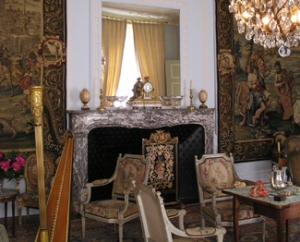
This is how the salon at the Château de Cirey looked in 2007 when I was kindly received there by the Comtesse de Salignac-Fénelon. Not precisely as it would have appeared in 1735 while Émilie du Châtelet was sheltering Voltaire at her home in this remote corner of the Champagne—but its grandeur alone would have enough to intimidate a lower-class gendarme, if he were ordered to investigate a crime on her premises …
Cavalier Constant, mounted policeman, had to do just that in Murder at Cirey, my first novel in the new series that Sapere Books are launching this year. Here is their announcement, accompanied by two more images to introduce the character whom some readers have dubbed ‘the Jack Reacher of the eighteenth century’. Thank you, Sapere Books.
New editions of all my novels by Sapere Books
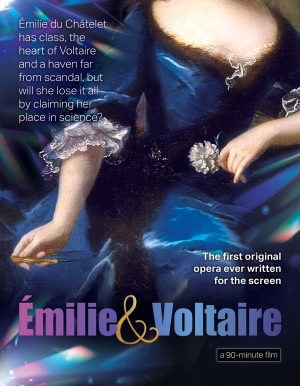
For the last year I've devoted much time and travel to finding an Executive Producer for the opera with Nicholas Gentile--see the cover of our Pitch Deck above--and securing a future for my historical novels.
I'm delighted to say I've just signed up with Sapere Books, who will be releasing ALL my previously published novels plus TWO NEW historical crime titles this year and in 2026.
I will post the dates as soon as I know them. in the meantime, I rejoice that eBooks and paperbacks of my books are returning to the marketplace.
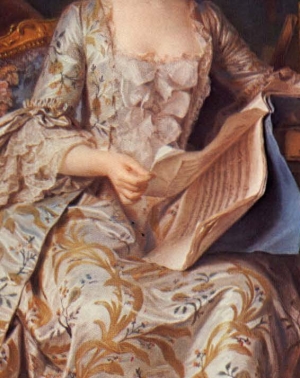
As it happens, Émilie du Chatelet plays the role of consultant detective in my three crime novels featuring the tenacious mounted gendarme, Victor Constant. You can see a portion of one of her famous portraits in the image above. I found it amusing when an Amazon reviewer once lamented Émilie's dominance over a ballistics discussion in Murder at Cirey--he was expecting Voltaire to be the most useful thinker on the spot. Of course, now we know that Émilie's mind was far more scientific than Voltaire's ...
I so look forward to extending Victor's investigations under the Sapere Books imprint.
Émilie du Châtelet 1738--Episode 3
Nicholas Gentile and I have written an opera about Émilie and Voltaire and were invited to speak about it to Sydney's Queen's Club. Episode 1 of the speech shows Émilie as a girl being shown off by her fond father as a prodigy in mathematics and natural science. With the approbation of her mother, she also excelled at the harpsichord. Episode 2 introduces Voltaire, on the same evening at the Breteuils’ Château de Preuilly in the Loire Valley. Here in Episode 3 they meet again, when Émilie is 27.
‘We are now at the royal opera house in Paris in 1733. It’s the first night of The Empire of Love and Voltaire has come along to applaud the librettist, Moncrif, who’s a friend of his. Émilie has come because she’s very fond of opera and goes often with one of her three best friends, who are all duchesses. When Voltaire and Émilie fall into conversation on that fateful night, Voltaire claims that he’s met her more than once before, through her late father, the receiver of the ambassadors at the court of Versailles, but Émilie denies ever having met Voltaire. Why is this? Possibly the social distance between them.
'A lot has happened over the last nineteen years. Émilie is married, to a gentleman of higher rank than her own, with no great wealth but considerable land, and she has been the Marquise du Châtelet since the age of nineteen, with privileges at Versailles, where she plays cards with the queen. The Marquis du Châtelet is the head of one of the eight great families of the Lorraine and his family heritage is with the army: he is colonel of an infantry regiment in the Rhineland. The marquis is kind and considerate, and although his own pursuits are utterly different from Émilie’s, he respects her learning and her determination to make progress in physics. She has repaid him impeccably by giving him children and comporting herself as befits their high station: that is, with dignity and discretion.
'What has Voltaire been doing over the last nineteen years? Well, he’s a best-selling playwright, he’s made a vast fortune in various kinds of business, almost all the philosophical books he’s published have been declared illegal, he’s been thrown into prison more than once, and the government has only just let him come back from three years’ exile in England. He’s arguably the funniest and most entertaining man in France, and altogether a dangerous person to know.
'But from the moment they start talking to each other, the love affair is inevitable. The beautiful Émilie is both passionate and impulsive, and Voltaire equals her in energy and eloquence. He is very generous: amongst his gifts to her—along with all the diamonds and sapphires and scientific instruments—are expensive lessons in mathematics from the famous geometer, Pierre-Louis de Maupertuis, who becomes a close friend.
'From the moment they begin the love affair, disaster is inevitable. Except for hearts and minds, this is a mismatch of incendiary proportions. Amongst the top echelons in the French monarchy, people are supposed to conduct liaisons at their own level and in strict secrecy—but Voltaire is bourgeois, and infamous, and his every move gives rise to scandal.
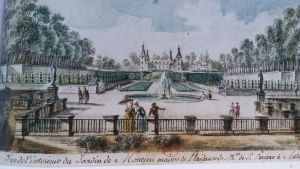
'Lovers are never supposed to be seen together in public, but in 1734 Émilie and Voltaire both appear at the wedding of a close friend, the Duc de Richelieu. The celebration is far off in Burgundy at the Château of Montjeu (pictured) and Émilie has her husband’s permission to attend. Nonetheless, it ends in tears: another friend in Paris sends them a warning that there is a warrant out for Voltaire’s arrest over a banned book, and the king has dispatched gendarmes to Burgundy to throw him in prison once again.
'Voltaire is frantic to get across the border to Switzerland or the Lorraine but Émilie is terrified she’ll never see him again. She persuades him to go to a Châtelet property in the Champagne province, and hide there incognito while she goes back to Paris and Versailles to beg for his freedom. His hideaway will be rarely used hunting lodge, well off the beaten track in the valley of the Upper Marne, named Cirey.’
From Facebook to facing books
I'm bowing out of Facebook and inviting readers to rediscover this website, so I'll be posting here more frequently from now on. My presence on social media and here was intended to bring people closer to my writing. And my principle project at the moment is the opera I've written with Nicholas Gentile, the first ever to be created specifically for the screen. So from now on the main topics on this blog will be Émilie du Chatelet, the film project Émilie & Voltaire, and my own writing, in that order.
After decades devoted to writing, I now recognise that Émilie & Voltaire brings to fruition something that I was searching for in 2011. Back then I conducted a secret interview with myself. Looking at it again today for the very first time, I realise that something I yearned for then has come into being, and it turns out not to be a novel but an opera libretto! Thanks to Nicholas and our film team, it will soon go out into the world. Here is my self-interrogation from 12 years ago, unedited.
Why do I write?
Because I’ve always liked to read stories and wanted to work that magic, of keeping someone enthralled when they’re curled up with a book. This is an old dream of mine. For the last two decades it’s been a drive, not very examined.
If it’s for a definable purpose, am I achieving that purpose?
Possibly there’s a purpose there, as I grow older, of telling something about the world of human beings, what they’ve done and what moves them. I don’t write from any psychology or sociology of history, though, and I don’t see any point in a catalogue of facts. Some readers looking for romance in my books find too many facts; others find the stories rich and dramatic. I don’t think I’ll ever know whether the purpose is being achieved. I should spend some time thinking about whether I have one, however.
Am I doing it more for me or for others?
The drive is deep so I guess it’s primarily for me. About me, though? Don’t think so.
Is it meant to have an effect on others’ lives?
I do want the reader to share my fascination with the events I touch on, so it’s partially an adventurous history lesson. And I want the characters to become part of the reader’s life for a while, to be believed in as complex creatures. Capable of surprising and disappointing. Capable of inspiration. The books are full of moral choices.
What sort of effect does it have now?
Varied. Some people cry when they read the books, usually in odd places. Fiona Henderson, my first publisher, cried when the Master died in La Créole. Nerrilee Weir, rights manager, dreamed of Jules from Rebel. The history grabs some people. Do my books make people think or change their view of the world? I’ve no idea.
What am I trying to express?
That we love. That as a species we keep love out of most of our dealings with others. That we can’t concentrate long enough on examining what we do. That our mistakes are monumental. That in our hearts we know what’s wrong.
Is my writing honest?
It uses story constructs hallowed by literary practice. If it were totally honest, perhaps it would be less planned, stranger. But maybe less powerful?
Does it reflect my deepest preoccupations?
Who knows? Deep preoccupations tend to stay down there, inside us, rarely recognised. So there’s no real answer to that question.
Is there any point in going on?
In the sense that writing is a discovery, yes.
If there is, what kind of writing do I want to do?
I want people to sit up and take notice of it. Why? I’m getting older and I still haven’t written a book that reaches out and moves a lot of people powerfully. I have a desire to do that. But until I find out why I have that desire, I’ll never write the book. I know it’s not basically a selfish impulse, but beyond that I’m not sure where it comes from or where it’s going.
Is writing my greatest talent, supposing I have any?
Yeah, for what it’s worth. Not much. Good enough perhaps if given free rein.
Would I achieve the (supposed) purpose better by another means?
No, not that I know of.
Is it a search for something?
Looks like it.